Mitragyna Speciosa: The Kratom Tree Explained
Mitragyna speciosa is the tropical evergreen tree whose leaves reach buyers as kratom. Before it is a powder in a pouch, it is a tall tree growing along rivers and forest edges in Southeast Asia. This guide covers its botany in plain terms: its family, how it looks, where it grows, and why the leaf is the part that matters.
Also, you can browse the shop, read what 7OH is or check where we deliver.
The Botanical Name and Family
The full scientific name is Mitragyna speciosa (Korth.) Havil. The abbreviations credit the botanists who described and later reclassified the plant in the nineteenth century. The usual explanation links the genus name Mitragyna to the shape of the flower’s stigma, which resembles a bishop’s mitre. Meanwhile, speciosa is Latin for showy or handsome.
The tree belongs to the Rubiaceae family, commonly called the coffee family. That makes kratom a botanical relative of the coffee plant, as well as of gardenias and many tropical shrubs. However, the relationship is a matter of plant classification: it describes shared flower and fruit structure, not any similarity in the leaf itself.
What the Kratom Tree Looks Like
In the wild, Mitragyna speciosa is a substantial tree rather than a shrub. Botanical descriptions record:
- Height: up to about 25 metres, with a trunk that can reach close to a metre across;
- Bark: a generally straight trunk with smooth, grey outer bark;
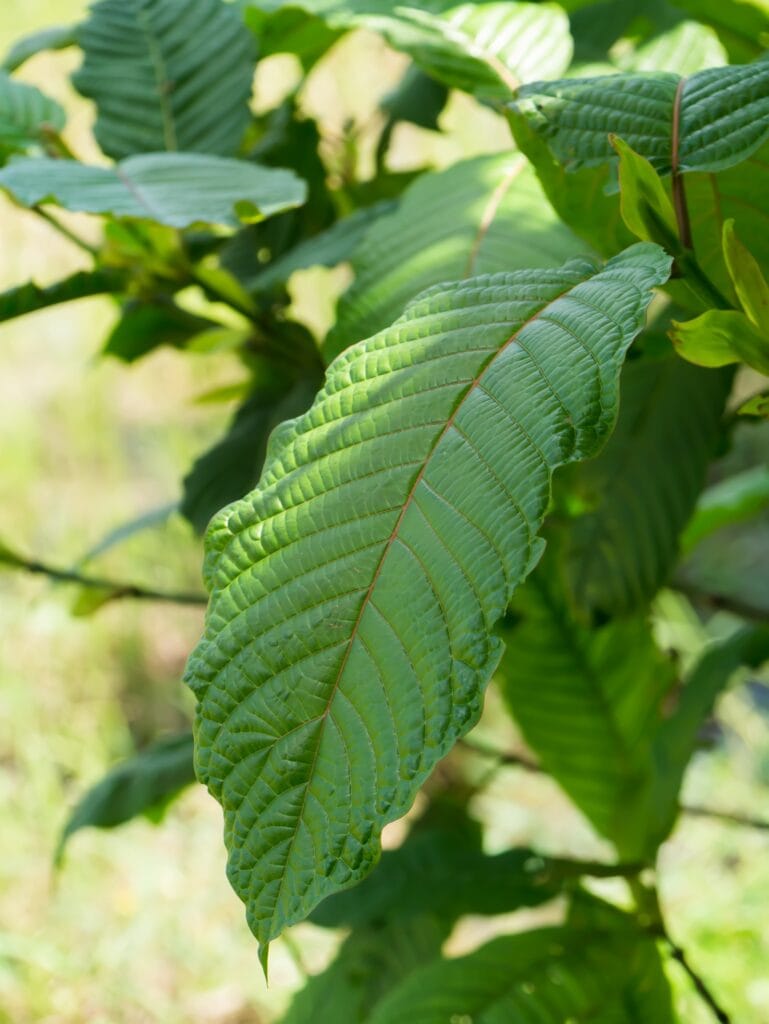
- Leaves: glossy, dark green and oval with a pointed tip, often 14 to 20 cm long and 7 to 12 cm wide;
- Veins: a central vein and side veins that can show red, green or pale colouring;
- Flowers: small yellow flowers packed into round clusters;
- Fruit: small capsules holding many tiny winged seeds.
The tree is evergreen, so it keeps its leaves year-round. At the same time, it sheds and replaces older leaves continuously, which is what allows repeated harvests from the same trees.
Where Mitragyna Speciosa Grows Naturally
The species is native to Southeast Asia. Its natural range includes Thailand, Malaysia, Indonesia (particularly Borneo and Sumatra), Myanmar, the Philippines and Papua New Guinea. It favours hot, humid lowlands with plenty of rain. For example, it often grows on riverbanks and in wet or seasonally flooded forest.
Today most of the kratom traded internationally comes from Indonesia, where trees grow both wild and on smallholder farms. Our guide to where kratom comes from covers the main source regions and what regional names on a label can and cannot tell you.
The Leaf, the Vein and the Harvest
The leaf is the only part of the tree that growers harvest for kratom. Workers pick the leaves by hand, often from mature trees, and then dry and mill them. The colour of the leaf’s vein at the time of picking is the origin of the red, green and white names used in the trade.
However, those vein colours are not separate species or botanical varieties. Instead, they describe the leaf, and how the trade sorts it, within the same species. Kratom strains explained covers how colour, region and processing combine into the names you see on a shelf. For what happens after picking, read from kratom leaf to powder.
Relatives in the Mitragyna Genus
Mitragyna speciosa is one of several species in its genus. Others, such as Mitragyna diversifolia, Mitragyna parvifolia and Mitragyna hirsuta, grow in parts of Asia and Africa. They can look similar, especially after drying and grinding.
Because dried leaf is hard to identify by eye, researchers have developed DNA-based methods to tell Mitragyna speciosa apart from its relatives. For buyers, this is one more reason a batch-specific laboratory report matters. In short, it is the practical way to confirm that a powder is the species it claims to be and that it is free of contaminants. See how to read a kratom COA.
How the Kratom Tree Reproduces and Spreads
After flowering, each round flower cluster develops into a head of small fruit capsules. When they ripen and split, they release large numbers of tiny seeds with papery wings. That design suits the tree’s habitat, because wind and water carry the light seeds. This is one reason the species so often appears strung along riverbanks and flood plains.
Most sources describe fresh seed as short-lived. For this reason, growers raising trees for leaf rely on fresh seed or young nursery plants rather than stored seed. A young tree needs several years of growth before it carries enough mature foliage for regular harvests. That is also part of why established trees along rivers remain such an important source of leaf in producing regions.
Can the Kratom Tree Grow in Canada?
Not outdoors. Mitragyna speciosa is a tropical tree that needs year-round warmth and high humidity, and it does not survive frost. Canadian winters rule out outdoor growing anywhere in the country. In addition, even a heated greenhouse struggles to match the rainfall and heat of its native range.
As a result, all kratom sold in Canada arrives as imported leaf. Producers have already dried and processed it in the regions where the tree grows. However, what you can control as a buyer is what happens next: freshness, storage and testing. Finally, kratom is legal to buy and own in Canada, and our legal guide explains the details.
Frequently Asked Questions
Is Mitragyna speciosa the same as kratom?
Yes. Mitragyna speciosa is the scientific name of the tree, and kratom is the common name for the tree and its dried leaf.
Is kratom related to coffee?
Botanically, yes. Both belong to the Rubiaceae family. However, the link is about flower and fruit structure used in plant classification, not about the leaf itself.
How tall does the kratom tree grow?
In its native habitat it can reach about 25 metres, with glossy leaves that are often 14 to 20 cm long.
Can Mitragyna speciosa be grown outdoors in Canada?
No. It is a frost-sensitive tropical tree that needs constant heat and humidity. Therefore, kratom sold in Canada arrives as imported dried leaf.
Related guides
What Is Kratom? A Simple Guide for Canadians
What kratom is, where it comes from, its legal status in Canada and how to spot lab-tested quality.
Green Maeng Da Kratom: The Strain Profile
What the Maeng Da name means, how the leaf is harvested and dried, and what a quality batch looks like.
Lab-Tested Kratom in Canada: How to Read a COA
What a kratom Certificate of Analysis should show, how to read each line, and the red flags that mean you should order elsewhere.
Where Does Kratom Come From? Kratom Source Regions
Mitragynine: Kratom's Main Alkaloid, Explained
Keep exploring
Shop lab-tested kratom
Same-day delivery across the Greater Toronto Area · Canada-wide shipping from Vaughan, Ontario.