Ashwagandha Canada: Rules, Labels and Quality Explained
If you are shopping for ashwagandha, Canada has a clear framework for how sellers can offer and label it. This guide explains what ashwagandha is, how Health Canada regulates it, what the Natural Product Number on a label tells you, and the quality checks that matter whether you buy root powder, an extract or capsules.
Also, you can see our ashwagandha product page, browse the shop or read about our team.
What Ashwagandha Is
Ashwagandha is the common name for Withania somnifera, a small woody shrub in the Solanaceae family, the nightshade family that also includes tomatoes and potatoes. It grows naturally across India, parts of the Middle East and Africa. In addition, farmers cultivate it on a large scale in India.
The part most often traded is the root, which producers dry and grind into a pale, tan-coloured powder or process into extracts. Ashwagandha has a long history in Ayurveda, the traditional system of medicine in India, which is where much of its reputation comes from.
However, it is botanically unrelated to kratom, which is a coffee-family tree. We sell both, but they are separate products with separate rules, covered separately below.
How Health Canada Regulates Ashwagandha
In Canada, products sold as natural health products fall under the Natural Health Products Regulations. A product sold that way needs a product licence from Health Canada before it can go on sale. Each licensed product then receives an eight-digit Natural Product Number (NPN) that appears on its label.
Health Canada has also published a monograph for ashwagandha. A monograph is a reference document that sets out accepted ingredient information, such as the plant part and preparation, for companies applying for a licence. It is guidance for product licensing, and it is the reason many ashwagandha capsule and extract products in Canadian stores carry an NPN.
Health claims also depend on that licensing process. An unlicensed product cannot make health claims. Therefore, a responsible seller of a plain botanical powder stays out of claims entirely.
What an NPN on the Label Tells You
An NPN tells you Health Canada has reviewed and licensed that specific product, including its ingredients, recommended conditions of use and label wording. It applies to the exact product, not to ashwagandha in general, so two ashwagandha products from different brands will have different NPNs.
- Where to find it: printed on the label as “NPN” followed by eight digits;
- How to check it: search the number in Health Canada’s Licensed Natural Health Products Database;
- What to compare: the product name, company and ingredients listed there should match the package.
If a product makes health claims but shows no NPN, that is a reason to look elsewhere.
Root Powder, Extracts and Capsules
Ashwagandha reaches Canadian shelves in three main formats, and the label should make clear which one you are looking at:
- Root powder: the whole dried root, ground. It should list a single ingredient, the root, with nothing added;
- Extracts: the root processed to concentrate its natural compounds. Extract labels often state a percentage of withanolides, the group of compounds people most associate with ashwagandha;
- Capsules and tablets: either powder or extract in a pre-measured shell, usually sold as licensed products with an NPN.
Knowing the format matters because the same weight of powder and of extract are not comparable products. In short, read the plant part, the form and the ingredient list together.
Quality Checks Before You Buy
- Latin name and plant part: Withania somnifera, root;
- Heavy-metal testing: root crops take up whatever is in the soil, so screening for lead, arsenic, cadmium and mercury matters;
- Single ingredient: for a powder, no fillers or flow agents unless the label lists them;
- Batch number: so you can trace the product to its test results;
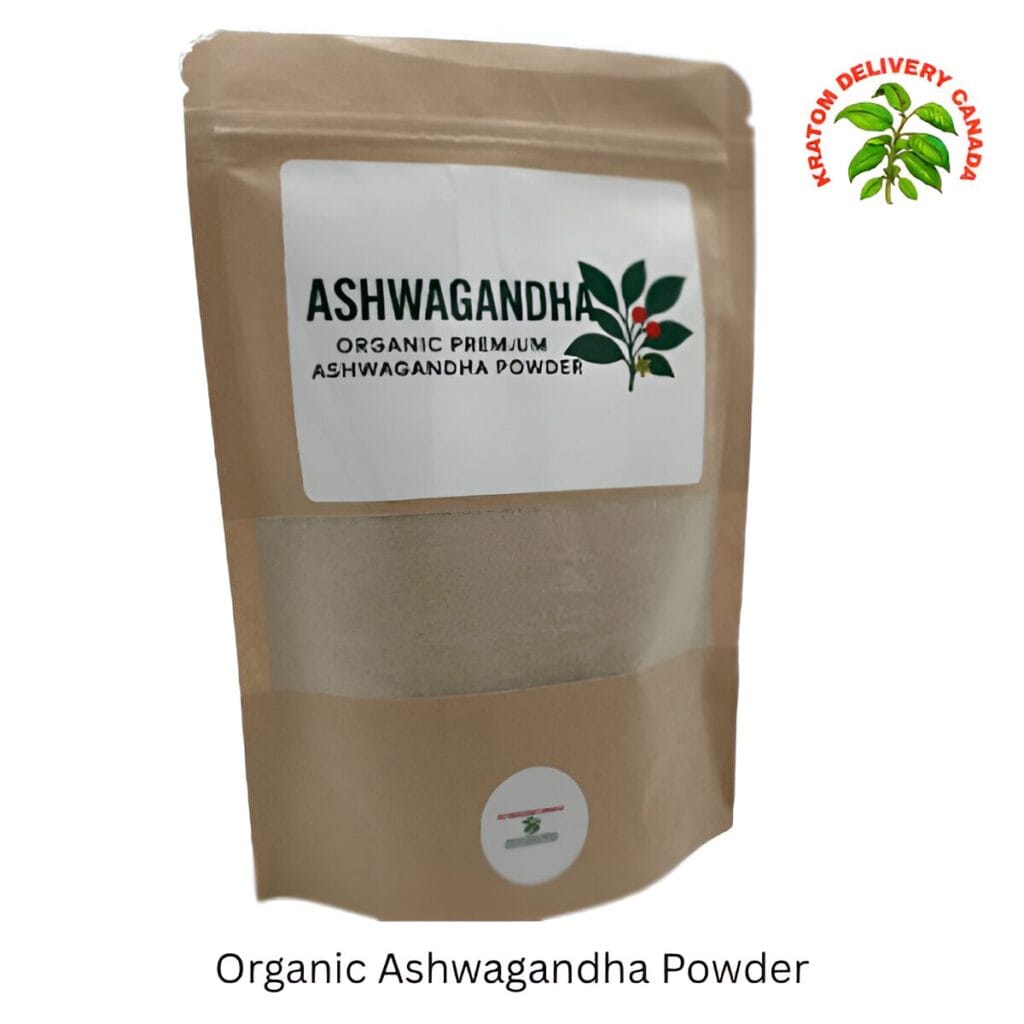
- Freshness: sealed, light-blocking packaging and a pale tan colour with an earthy smell.
“Organic” is a sourcing claim worth understanding on its own terms. Our guide to organic ashwagandha powder explains what certification covers.
Ashwagandha From Kratom Delivery Canada
We carry an organic ashwagandha root powder alongside our lab-tested kratom. We sell it as a botanical powder, without health claims. It also ships the same way as the rest of our range: same-day delivery across most of the Greater Toronto Area and tracked shipping to the rest of Canada.
If you have a question about a batch, including its test results, contact us with the product name. For delivery times to your area, see where we deliver.
Storing Ashwagandha Powder
Like any dried botanical, ashwagandha root powder keeps best away from heat, light, air and moisture. Therefore, keep it in its sealed pouch or an airtight, opaque container in a cool, dry cupboard, and close it promptly after opening. Humidity is the main enemy: powder that has taken on moisture can clump and lose its fresh smell.
Also, avoid storing it above the stove, beside a kettle or in a bathroom, where heat and steam are constant. Finally, a musty smell or visible clumping are signs of poor storage and a powder past its best.
Frequently Asked Questions
Is ashwagandha legal in Canada?
Yes. Many shops in Canada sell ashwagandha, and products sold as natural health products carry an eight-digit NPN from Health Canada.
What does NPN stand for?
Natural Product Number. Health Canada issues it to a specific licensed natural health product, and the number appears on its label.
Which part of the ashwagandha plant is used?
Mainly the root, which producers dry and grind into powder or process into extracts.
Is ashwagandha related to kratom?
No. Ashwagandha is in the nightshade family, while kratom is a coffee-family tree. They are different plants with different rules.
Related guides
Organic Ashwagandha Powder: Sourcing and Quality Explained
What organic certification covers for ashwagandha root powder, and the quality checks to make before buying.
Lab-Tested Kratom in Canada: How to Read a COA
What a kratom Certificate of Analysis should show, how to read each line, and the red flags that mean you should order elsewhere.
Kratom vs Kava: How the Two Botanicals Differ
Two unrelated botanicals compared: different plants, regions, chemistry and Canadian rules.
Bulk Kratom Canada: How to Buy and Store Kratom by the Kilo
Kratom vs Kava: How the Two Botanicals Differ
Keep exploring
Shop lab-tested kratom
Same-day delivery across the Greater Toronto Area · Canada-wide shipping from Vaughan, Ontario.